Pages

Monday, July 6, 2009

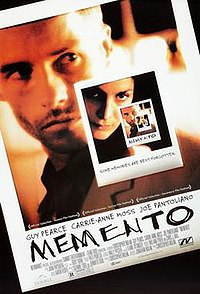
Memento

Memento is a 2000 psychological thriller film written and directed by Christopher Nolan, adapted from his brother Jonathan's short story "Memento Mori". It stars Guy Pearce as Leonard Shelby, a former insurance fraud investigator searching for the man he believes raped and killed his wife during a burglary. Leonard suffers from anterograde amnesia, which he contracted from severe head trauma during the attack on his wife. This renders his brain unable to store new memories. To cope with his condition, he maintains a system of notes, photographs, and tattoos to record information about himself and others, including his wife's killer. He is aided in his investigation by Teddy (Joe Pantoliano) and Natalie (Carrie-Anne Moss), neither of whom he can trust.

This feature is often used to show the distinction between plot and story. The film's events unfold in two separate, alternating narratives—one in color, and the other in black and white. The black and white sections are told in chronological order, showing Leonard conversing with an anonymous phone caller in a motel room. Leonard's investigation is depicted in five-minute color sequences that are in reverse chronological order. As each scene begins, Leonard has just lost his recent memories, leaving him unaware of where he is or what he was doing. The scene ends just after its events fade from his memory. By reversing the order, the spectator is unaware of the preceding events, just like Leonard. By the film's end, the two narratives converge in a single sequence that begins as black and white and fades into color.

Leonard Shelby (Guy Pearce) wears expensive, European tailored suits, drives a late model Jaguar sedan, but lives in cheap, anonymous motels, paying his way with thick wads of cash. Although he looks like a successful businessman, his only work is the pursuit of vengeance: tracking and punishing the man who raped and murdered his wife. His suspicions dismissed by the police, Leonard's life has become an all-consuming quest for justice.
The difficulty, however, of locating his wife's killer is compounded by the fact that Leonard suffers from a rare, untreatable form of memory loss. Although he can recall details of life before his "accident", Leonard can't remember what happened fifteen minutes ago, where he is, where he's going or why. A former insurance investigator, Leonard is keenly aware of his handicap. Moreover, he's got the discipline to compensate as well as the motivation-the cruel memory of his beloved wife's last moments. Haunted by what he's lost, he's re-built his life out of index cards, photographs, file folders, charts, tattoos and obsessive habits that stand in for memory, fixing him in space and time and connecting him to his mission.
Out of necessity, Leonard must rely on others despite being thoroughly ill-equipped to assess either their motives or basic decency. Leonard remembers his past-up to a point. But just who has Leonard become since losing the ability to hold together the fragments of himself? "Memento" mines this psychological terrain, using non-linear film narrative to mirror Leonard's own effort to interpret the random pieces of evidence he hoards. The murder, rewound in the opening frames, we discover, is logically the endpoint of Leonard's story. What we learn comes from a point earlier in time, a few moments and a few sentences prior to what we've already been shown. As Leonard's story unfolds, the meaning of events changes. Allies, enemies, victims, victimizers swap place almost kaleidoscopically.

Memento premiered on September 5, 2000 at the Venice Film Festival to critical acclaim and received a similar response when it was released in theaters on December 15, 2000. Critics especially praised its unique, nonlinear narrative structure and themes of memory, perception, grief, self-deception, and revenge. The film was successful at the box office and received numerous accolades, including Academy Award nominations for Original Screenplay and Editing.


Friday, April 3, 2009

Lions for Lambs

Lions for Lambs is a 2007 American drama film about the connection between a platoon of United States soldiers in Afghanistan, a U.S. senator, a reporter, and a California college professor. It stars Tom Cruise, Meryl Streep, and Robert Redford. It was the first Cruise/Wagner Productions film since the company joined with United Artists subsequent to Cruise's falling out with Paramount Pictures in 2006.

Robert Redford directs this dramatic tale of intersecting lives that weaves together the stories of an idealistic professor's attempts to inspire a privileged student, a former student of the teacher who is wounded behind enemy lines in Afghanistan, and a congressman whose interactions with a seasoned journalist reveal much about the man behind the public persona. Tom Cruise, Meryl Streep, and Robert Redford star in a film scripted by Matthew Michael Carnahan.

With a title that alludes to incompetent leaders sending brave soldiers into the slaughter of battle, the film takes aim at the U.S. government's prosecution of the wars in the Middle East, showing three different simultaneous stories: a congressman who launches a new military strategy and details it to a journalist, two soldiers involved in said operation, and their college teacher trying to re-engage a promising student. The film was written by Matthew Michael Carnahan, and directed by Redford. It was released in North America on Friday, November 9, 2007, to mixed but mostly negative reviews and disappointing box office receipts.

The film was partly based on Operation Red Wing, an unsuccessful SEAL operation in Afghanistan.

Wednesday, March 25, 2009

No Country for Old Men

No Country for Old Men is a 2007 crime thriller film adapted for the screen and directed by Joel and Ethan Coen, and starring Tommy Lee Jones, Javier Bardem, and Josh Brolin. Adapted from the Cormac McCarthy novel of the same name, No Country for Old Men tells the story of a botched drug deal and the ensuing cat-and-mouse drama, as three men crisscross each other's paths in the desert landscape of 1980 West Texas. The film examines the themes of fate and circumstance the Coen brothers have previously explored in Blood Simple and Fargo.

No Country for Old Men has been highly praised by critics. Roger Ebert of the Chicago Sun-Times called it "as good a film as the Coen brothers...have ever made." Guardian journalist John Patterson said the film proved "that the Coens' technical abilities, and their feel for a landscape-based Western classicism reminiscent of Anthony Mann and Sam Peckinpah, are matched by few living directors." The film was honored with numerous awards, garnering three British Academy of Film awards, two Golden Globes, and four Academy Awards for Best Picture, Best Director (Joel and Ethan Coen), Best Adapted Screenplay and Best Supporting Actor (Javier Bardem).

No Country for Old Men premiered in Competition at the Cannes Film Festival on May 19, 2007. The film commercially opened in limited release in 28 theaters in the United States on November 9, 2007, grossing $1,226,333 over the opening weekend. The film expanded to a wide release in 860 theaters in the United States on November 21, 2007, grossing $7,776,773 over the first weekend. The film subsequently increased the number of theaters to 2,037. The film opened in Australia on December 26, 2007, and in the United Kingdom (limited release) and Ireland on January 18, 2008. As of February 13th, 2009, the film has grossed $74,283,000 domestically (United States).

No Country for Old Men was nominated for eight Academy Awards and won four, including Best Picture. Additionally, Javier Bardem won Best Performance by an Actor in a Supporting Role; the Coen Brothers won Achievement in Directing (Best Director) and Best Adapted Screenplay. Other nominations included Best Film Editing (the Coen Brothers as Roderick Jaynes), Best Cinematography (Roger Deakins), Best Sound Editing and Best Sound Mixing.

The film was nominated for four Golden Globe Awards, winning two at the 65th Golden Globe Awards. Javier Bardem won Best Performance by an Actor in a Supporting Role in a Motion Picture and the Coen Brothers won Best Screenplay – Motion Picture. The film was also nominated for Best Motion Picture – Drama, and Best Director (Coen Brothers). Earlier in 2007 it was nominated for the Palme d'Or at the Cannes Film Festival. The Screen Actors Guild gave a nomination nod to the cast for its "Outstanding Performance". The film won top honors at the Directors Guild of America Awards for Joel and Ethan Coen. The film was nominated for nine Orange British Academy Film Awards's in 2008 and won in three categories; Joel and Ethan Coen winning the award for Best Director, Roger Deakins winning for Best Cinematography and Javier Bardem winning for Best Supporting Actor. It has also been awarded the David di Donatello for Best Foreign Film.

Consonant with the positive critical response, No Country for Old Men received widespread formal recognition from numerous North American critics' associations (New York Film Critics Circle, Toronto Film Critics Association, Washington D.C. Area Film Critics Association, National Board of Review, New York Film Critics Online, Chicago Film Critics Association, Boston Society of Film Critics, Austin Film Critics Association, and San Diego Film Critics Society). The American Film Institute listed it as an AFI Movie of the Year for 2007, and the Australian Film Critics Association and Houston Film Critics Society both voted it best film of 2007.

Thursday, March 12, 2009

Burn After Reading


Burn After Reading is a 2008 American black comedy film written, produced, and directed by Joel and Ethan Coen. The film stars George Clooney, John Malkovich, Tilda Swinton, Frances McDormand, Richard Jenkins, and Brad Pitt. It was released in the United States on September 12, 2008, and it was released on October 17, 2008 in the United Kingdom. The film had its premiere on August 27, 2008, when it opened the 2008 Venice Film Festival. The film is the brothers' first film following their Academy Award for Best Picture-winning No Country for Old Men.

Osbourne Cox, a Balkan expert, is fired at the CIA, so he begins a memoir. His wife wants a divorce and expects her lover, Harry, a philandering State Department marshal, to leave his wife. A diskette falls out of a gym bag at a Georgetown fitness center. Two employees there try to turn it into cash: Linda, who wants money for elective surgery, and Chad, an amiable goof. Information on the disc leads them to Osbourne who rejects their sales pitch; then they visit the Russian embassy. To sweeten the pot, they decide they need more of Osbourne's secrets. Meanwhile, Linda's boss likes her, and Harry's wife leaves for a book tour. All roads lead to Osbourne's house.

With their overtly comedic follow-up BURN AFTER READING, the Coen Brothers return--about a third of the way--from the dark, dank recesses of the human psyche they traversed in their Oscar-winning NO COUNTRY FOR OLD MEN. For those unfamiliar with the landscape of modern movie psychoanalysis, this puts the fraternal filmmakers square in the cruel, misanthropic, and farcical realm of their 1990s-era body of work, somewhere between the tragicomic crime thriller of FARGO and the disconnected noir-homage anti-storytelling of THE BIG LEBOWSKI, with 2007's NO COUNTRY retroactively adding new nihilism-tinged dimensions of smart skepticism to the proceedings.
In a more linear trajectory, BURN AFTER READING also stands as the third entry, after BLOOD SIMPLE and FARGO, in what could be an unofficial Tragedy of Human Idiocy trilogy, wherein characters make the most outlandishly moronic moves to devastating consequences simply by adhering to true human behavior. Indeed, Carter Burwell's emotionally weighty score, which washes over biting scenes of explosive, anesthetizing belly laughs, is very reminiscent of his FARGO work. BURN is ostensibly structured and propelled by a spy-thriller plotline involving a classified CD lost by a disgraced CIA spook and found by two simple gym employees. But, in actuality, it's simply--amazingly--a collection of brilliant caricature studies interwoven by veracious, if Coenesque, social interactions, as epitomized by the pathos of the Frances McDormand character's precipitous quest for cosmetic surgery.

Reviews for the film were mostly positive, earning a 77% "Certified Fresh" rating at Rotten Tomatoes based on 213 reviews as of November 26, 2009. The film fared worse among "Top Critics," earning a 59% "Certified Fresh" rating out of 39 reviews. The Times, which gave the movie four out of five stars, compared it to Coen films Raising Arizona and Fargo in its "savagely comic taste for creative violence and a slightly mocking eye for detail."

The movie was nominated at the 2009 Golden Globe awards for Best Comedy or Musical and for Best Lead Actress in a Comedy or Musical. The National Board of Review named Burn After Reading to their list of the Top 10 Movies of 2008. Noel Murray of The A.V. Club named it the second best film of 2008, Empire magazine named it the third best film of 2008, and Owen Gleiberman of Entertainment Weekly named it the seventh best film of 2008.

Reference Links:


Tuesday, February 10, 2009

The Bank Job


The Bank Job is a 2008 British crime film directed by Roger Donaldson and starring Jason Statham, based on the 1971 Baker Street robbery in central London, from which the money and valuables stolen were never recovered. The producers allege that the story was prevented from being told because of a D-Notice (now known as a DA-Notice) government gagging request, allegedly to protect a prominent member of the British Royal Family. According to the producers, this movie is intended to reveal the truth for the first time, although it includes significant elements of fiction.

In September 1971, thieves tunneled into the vault of a bank in London's Baker Street and looted safe deposit boxes of cash and jewelry worth over three million pounds. None of it was recovered. Nobody was ever arrested. The robbery made headlines for a few days and then disappeared - the result of a 'D' Notice, gagging the press. This film reveals what was hidden for the first time. The story involves murder, corruption and a sex scandal with links to the Royal Family - a story in which the thieves were the most innocent people involved.


Inspired by the infamous 1971 robbery that took place at the Lloyds Bank in Marylebone London, LIONSGATE's ® The Bank Job stars Jason Statham (Transporter, Snatch, Crank, Italian Job) and Saffron Burrows (Klimt, Enigma). The highly-charged heist thriller tautly interweaves high-level corruption, murder and sexual scandal in 1970s England.

A car dealer with a dodgy past and new family, Terry (Statham) has always avoided major-league scams. But when Martine (Burrows), a beautiful model from his old neighborhood, offers him a lead on a foolproof bank hit on London's Baker Street, Terry recognizes the opportunity of a lifetime. Martine targets a roomful of safe deposit boxes worth millions in cash and jewelry. But Terry and his crew don't realize the boxes also contain a treasure trove of dirty secrets - secrets that will thrust them into a deadly web of corruption and illicit scandal that spans London's criminal underworld, the highest echelons of the British government, and the Royal Family itself...the true story of a heist gone wrong...in all the right ways.

Reference Links: